Are Cruise Ship Entertainers Employees?

afro american jazz pianist

If they weren’t on cruise ships HMRC would probably argue that they were employees but in the case of cruise ships they argue the opposite.

Pete Matthews (1) Keith Sidwick (2) v Revenue & Customs [2011] UKFTT 24 (TC)

Mr Sidwick was a musician and played piano on a series of cruise ships. Mr Matthews was a juggler, similarly entertaining passengers on cruise ships. Both were subject to a close degree of control by the ships officers but the First-tier Tribunal found that this degree of control was required by the context of a cruise ship.

The First-tier Tribunal concluded that the entertainers were not employees ‘…but earn their living by entering into a series of separate engagements with a number of different cruise lines in a similar way to actors…’

The reason why HMRC argued against employment was to stop a claim for Seafarers Earnings Deductions.

To get the deduction you must:

  • work on a ship. Oil rigs and other offshore installations aren’t ships for the purposes of Seafarers’ Earnings Deduction – but cargo vessels, tankers, cruise liners and passenger vessels are
  • work all or part of the time outside the UK. This means that for each employment you must carry out duties on at least one voyage per year that begins or ends at a foreign port
  • be resident in the UK or resident for tax purposes in a European Economic Area (EEA) State (other than the UK) – find out more by following the link ‘Check your residence status’ in the section below

You get the deduction from your earnings as a seafarer if you have an ‘eligible period’ of at least 365 days that consists mainly of days when you are absent from the UK.

From 6 April 2013 the rules that determine if someone is resident in the UK for tax purposes have been put on a statutory basis. These rules are known as the Statutory Residence Test (SRT).

steve@bicknells.net

Why Doctors should use Salary Sacrifice for CPE

Young Doctor with display board

Doctors often agree to pay for their own continuing training personally because of a shortage of NHS funds but when they do pay for courses its unlikely they will be able to claim tax relief.

EIM32530 states that it is well established that employees are not entitled to an expenses deduction under Section 336 ITEPA 2003 for the expenses continuing professional education (CPE). The Commissioners and the Courts have traditionally held that the duties of trainee doctors, for the purpose of the expenses rule, are limited to the clinical work that they do for the NHS Trust by whom they are employed. Their training activities are not undertaken “in the performance of” those duties for the purpose of Section 336 . That is so even though the training activities may be compulsory, and failure to complete them may lead to the employee losing his or her professional qualifications, and/or their job.

The Commissioners and the Courts upheld that view in a number of cases, as follows:

Parikh v Sleeman (63TC75) – a hospital doctor was refused relief for the expenses of attending training courses during periods of study leave.

Snowdon v Charnock (SpC282) – a specialist registrar was refused relief for the expenses of undergoing mandatory personal psychotherapy.

Consultant Psychiatrist v CIR (SpC557) – an NHS consultant was refused relief for the expenses of CPE necessary to maintain her professional qualification.

Decadt v CRC (TL3792) – a specialist registrar was refused relief for the expenses of taking professional examinations, even though it was a condition of his employment that he should do so.

In the recent case of Revenue & Customs Commissioners v Dr Piu Banerjee ([2010] EWCA Civ. 843), the Court of Appeal accepted that a deduction for training costs incurred by an employee should be allowed if the employee was employed on a training contract where training was an intrinsic contractual duty of the employment (see also EIM32535 & EIM32546) and where any personal benefit, unlike most CPE courses, would be incidental and not therefore give rise to a dual purpose of the expenditure.

Salary Sacrifice solves this problem.

Salary sacrifice works particularly well for training because except in the most extreme cases, employees cannot claim a tax deduction for training costs that they pay personally but if the employer pays for training that is work-related:

  • the employer gets the tax deduction
  • the employee is not taxed on the cost and
  • there is no National Insurance to pay.

EIM01210 confirms this.

steve@bicknells.net

Have you paid too much National Insurance?

dreamstimefree_75244

Unlike Income Tax which is cumulative and assessed across all earnings, National Insurance starts from zero on each individual employment and you also pay National Insurance on Self Employed earnings.

So if you are a Director of multiple businesses paid as an employee its easy to see how you could over pay and you might not even realise because National Insurance is not shown on your Self Assessment Return.

You can also over pay National Insurance if you are a part time employee with multiple employers and irratic earnings, this because National Insurance is calculated on a weekly/monthly basis, not a cumulative basis and its by employer.

What you need to do

Write to HM Revenue and Customs confirming:

  • your National Insurance number
  • why you’ve overpaid
  • the tax year(s) you’ve overpaid

You should include your P60 or a statement from your employer showing the tax and National Insurance for each year you’re claiming for.

You should apply within 6 years of the tax year you’re claiming for.

HM Revenue and Customs
Payment Reconciliation
National Insurance Contributions Office
Benton Park View
Newcastle upon Tyne
NE98 1ZZ

steve@bicknells.net


Can you recover VAT on Business Acquisition Costs?

Due diligence concept

Basically HMRC disallow Input VAT relating to Investments.

The most well known example of this was when BAA purchased Airport Development Investments Limited in June 2006, the decision was upheld by the Court of Appeal in February 2013.

The BAA VAT group sought to recover the VAT (£6.7m) incurred on the acquisition costs but recovery was refused by HMRC on the basis that they considered ADIL had not made onward taxable supplies, had not demonstrated any intention to make taxable supplies and was not a member of the VAT group at the time costs were incurred.

BAA used an SPV (Ferrovial) to purchase ADIL but did not bring the SPV into the BAA VAT Group until September 2006, 3 months after the acquisition.

The lessons to learn from this are:

  1. Once you have successfully made the acquisition join a VAT Group immediately and make it clear in correspondence that the SPV intends to join the VAT Group at the earliest opportunity
  2. Consider not using an SPV
  3. Buy the Assets instead of the Shares
  4. Show that the SPV will make taxable management charges
  5. Consider the scope of the advisors work, HMRC may disallow advice focussed on passively holding shares

steve@bicknells.net


Where should you pay tax? (Statutory Residence Test)

Flugzeug fliegend

Historically some of the key cases related to Pilots.

Shepherd v Revenue and Customs Commissioners [2007] BTC 426, [2006] EWHC 1512 (Ch)

A BA pilot had a home in Cyprus and spent 80 days in the UK (well below the 183 day test) in 1999/2000. However, he had ties to his former matrimonial home in Berkshire and the UK was his base for international flights, HMRC won the case on the basis that he had not ‘left the UK’.

Grace v Revenue & Customs [2008] Spc 663

Mr Grace was also a BA pilot, he claimed to have relocated to South Africa. Mr Grace won his case because he was set out the facts in a way that convincingly showed his links to his new country of residence. Although subsequently the outcome was reversed.

Gaines-Cooper Case

Robert Gaines-Cooper was a Multi Millionaire, based in the Seychelles but subject to the UK tax because of family ties

These cases demonstrate the problems of deciding residency, so on the 6th April 2013 a new Statutory Residence Test was introduced.

This test is relevent not only to Aircrew but also to:

  • Ships Crew
  • Lorry Drivers
  • Coach Drivers
  • Sales People
  • Travel Industry

UK ties are likely to be a key issue:

  1. Family Tie – Relevent relationships include Spouse, Child under 18, Common Law partner resident in the UK. However, Children in Full Time education are ok provided they don’t spend more than 21 days in the UK outside of term time.
  2. Accomodation Tie – A property in the UK where they can live for 91 days a year or 16 days if its owned by a close relative.
  3. Work Tie – Work in the UK for at least 3 hours a day for 40 days a year
  4. 90 Day Tie – Spend more that 90 days in the UK in this tax year or the previous tax year or the year before that
  5. Country Tie – the midnight test for the greatest number of days

On the positive side at least HMRC have been very specific in their guidance, these are are very specific tests!

steve@bicknells.net

 

Is my hobby a business?

Shopping chart on notebook isolated

The criteria used to assess if an activity is a hobby or a business are:

  • The size and commerciality of the activity.
  • The frequency of the activity and transactions
  • The application of business principles.
  • Whether there is a genuine profit motive.
  • The amount of time devoted to the activities.
  • The existence of arm’s-length customers (as opposed to just selling your wares to family and friends).

HMRC have some great examples to help you decided, for example

Gail is a full-time employee working for a stationery company. She pays her PAYE tax on this employment every month.

In her free time Gail makes cushions and uses most of them in her home. Occasionally she sells them to friends and work colleagues for an amount that just covers the cost of materials of £15. Sometimes she makes a loss. Any money she does make goes towards her holiday fund.

She decides to make extra cash by selling cushions on an Internet auction site and starts auctioning three or four to see how they go. They all sell for more than £50, a profit of at least £35 each.

She uses this money to buy more materials and within a month she is selling around ten cushions a week, always at a profit, and is considering setting up her own website.

Gail’s initial sales of cushions to friends are not classed as trading. It lacks commerciality and she does not set out to make a profit. The occasional sales are a by-product of her hobby. Once she begins to auction her cushions, she has moved into the realms of commerciality.

She is systematically selling her goods to make a profit. She will need to inform HMRC about her trade, and keep records of all her transactions. On the level of sales shown in the example the potential turnover of around £26,000 is well below the VAT annual threshold so Gail does not need to register for VAT.

You can find more examples at HMRC

Many traders start off in a small way and don’t realise that they need to register with HMRC, they assume their activity will be treated as a hobby, but things can grow quickly.

You should register as Self Employed as soon as your hobby becomes a commercial venture, even if you are losing money!

If you don’t register, HMRC will be looking for you and if you have an online business it won’t be hard for them to find you.

Ebay say they work ‘hard to ensure that businesses that trade on the platform are aware of their tax obligations’.

It added: ‘We do not hesitate to share information with government agencies should there be evidence of wrongdoing. We require all sellers trading as a business on eBay to register for a business account.’

steve@bicknells.net

Overseas property investors – are you ready for CGT in 2015

Taxes

In the Autumn Statement 2013 it was announced that a CGT charge will be introduced from April 2015 on ‘future’ capital gains made by non-UK residents disposing of UK residential property. George Osborne said…

“Britain is an open country that welcomes investment from all over the world, including investment in our residential property”

“But it’s not right that those who live in this country pay capital gains tax when they sell a home that is not their primary residence – while those who don’t live here do not. That is unfair.”

UK Residents typically pay capital gains tax at 28% on any profit from selling property that is not considered their primary residence.


 Reuters reported in Dec 2013…

Property lawyers and estate agents said foreign owners would be relieved the tax will not apply to historic gains before 2015. But they cautioned that the overall impact could be marginal as many foreign investors see London property as a safe and profitable place to park capital.

“Tax is not the primary driver for the majority of international buyers of residential property in London,” Knight Frank’s head of global research, Liam Bailey, said.

“It is important to note that the change to CGT rules brings the UK in line with other key investor markets, such as New York and Paris, where equivalent taxes can approach 35-50 percent depending on the owner’s residency status.”

It was not immediately clear how the tax would be collected and how it would apply if foreign owners used a domestic company to purchase property.

When a company disposes of an asset and makes a capital gain, as the main rate of corporation tax in 2014 is 21% (20% small profits rate) there could be a future tax saving opportunity for overseas investors to transfer property to limited companies.

There are other tax implications for example ATED (Annual Tax on Enveloped Dwellings) and SDLT (Stamp Duty Land Tax) but now could be a good time to consider your options.

steve@bicknells.net

How do you tell HMRC a company is dormant or active?

relax

Dormant is a term that HMRC and Companies House use for a company or organisation that is not active, trading or carrying on business activity. But HMRC and Companies House use the term dormant in slightly different ways.

For Corporation Tax purposes, HMRC views a dormant company as a company that’s not active, not liable for Corporation Tax or not within the charge to Corporation Tax.

A dormant company can be, for example:

  • a new company that’s not yet trading
  • an ‘off-the-shelf’ or ‘shell’ company held by a company formation agent intending to sell it on
  • a company that will never be trading because it has been formed to own an asset such as land or intellectual property
  • an existing company that has been – but is not currently – trading
  • a company that’s no longer trading and destined to be removed from the Companies Register

Generally your company or organisation is considered to be active for Corporation Tax purposes when it is, for example:

  • carrying on a business activity such as a trade or professional activity
  • buying and selling goods with a view to making a profit or surplus
  • providing services
  • earning interest
  • managing investments
  • receiving any other income

This definition of being active for Corporation Tax purposes is not necessarily the same as that used by HMRC in relation to other tax areas such as VAT, or by other government agencies such as Companies House.

If your limited company has been dormant but is now active, you must tell HMRC within three months of starting your tax accounting period. The best way to do this is to use HMRC’s online registration service.

HMRC have further details on this link

To contact HMRC you will need your Company UTR number and the 3 digit tax office number, then you can use this link to find out contact details for you Corporation Tax Office

When you call, Option 3 is for Dormant Companies and Option 4 is for Active Companies.

Then you will need to write to HMRC to advise them of the change in activity status.

Companies House still require Annual Returns and Annual Accounts even if the company is dormant, but these are obviously easy as there are no changes from the previous year.

steve@bicknells.net


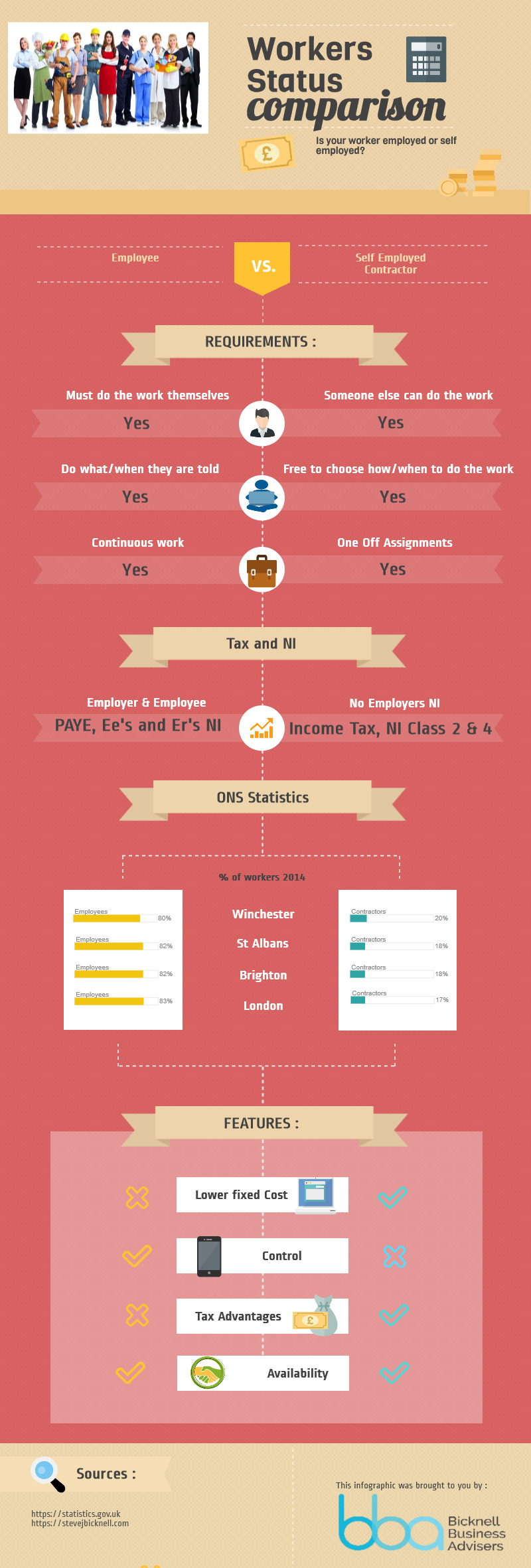
What are the differences between employees and contractors?

According to figures released by the Office for National Statistics last week, self-employment is at its highest level since records began almost 40 years ago.

There are currently 4.6 million people self-employed, with the proportion of the total workforce that are making a living for themselves sitting at 15%, compared to 13% in 2008 and less than 10% in 1975.

As highlighted by Everreach and the Daily Mail.

A worker’s employment status, that is whether they are employed or self-employed, is not a matter of choice. Whether someone is employed or self-employed depends upon the terms and conditions of the relevant engagement.

Many workers want to be self-employed because they will pay less tax, this calculator gives you a quick comparison between being employed, self employed or taking dividends in a limited company.

HMRC have a an employment status tool to help you determine whether a worker can be self-employed or should be an employee http://www.hmrc.gov.uk/calcs/esi.htm

Workers

steve@bicknells.net

How do you handle Input VAT on Insurance Claims?

insurance design

This often causes confusion, firstly because many people wrongly assume that IPT (Insurance Premium Tax) is VAT, it isn’t! and then when they make a claim they may get a VAT only invoice.

HMRC VIT13500 has the answer…

Insurers cannot recover any VAT incurred in obtaining replacement goods or having repairs carried out for a policy holder. The supply of goods (or services in the case of repairs) is considered to be made to the policy holder. This is so even when payment is made directly to the supplier by the insurer.

Subject to the normal rules a VAT registered policy holder may treat any VAT incurred on the supply as input tax. The insurer will normally pay the policy holder compensation exclusive of VAT. The policy holder will pay the supplier the tax and recover it as input tax.

If an insurance claim is for loss or damage at a domestic property you should make sure that any VAT claimed as input tax relates only to goods used for a business purpose.

Insurance and reinsurance is exempt from VAT under article 135 of the Sixth VAT Directive.

This also explains why an insurer may ask a contractor engaged in repair work not to invoice them VAT, its simply that they want the VAT only element to be invoiced to the insured.

steve@bicknells.net